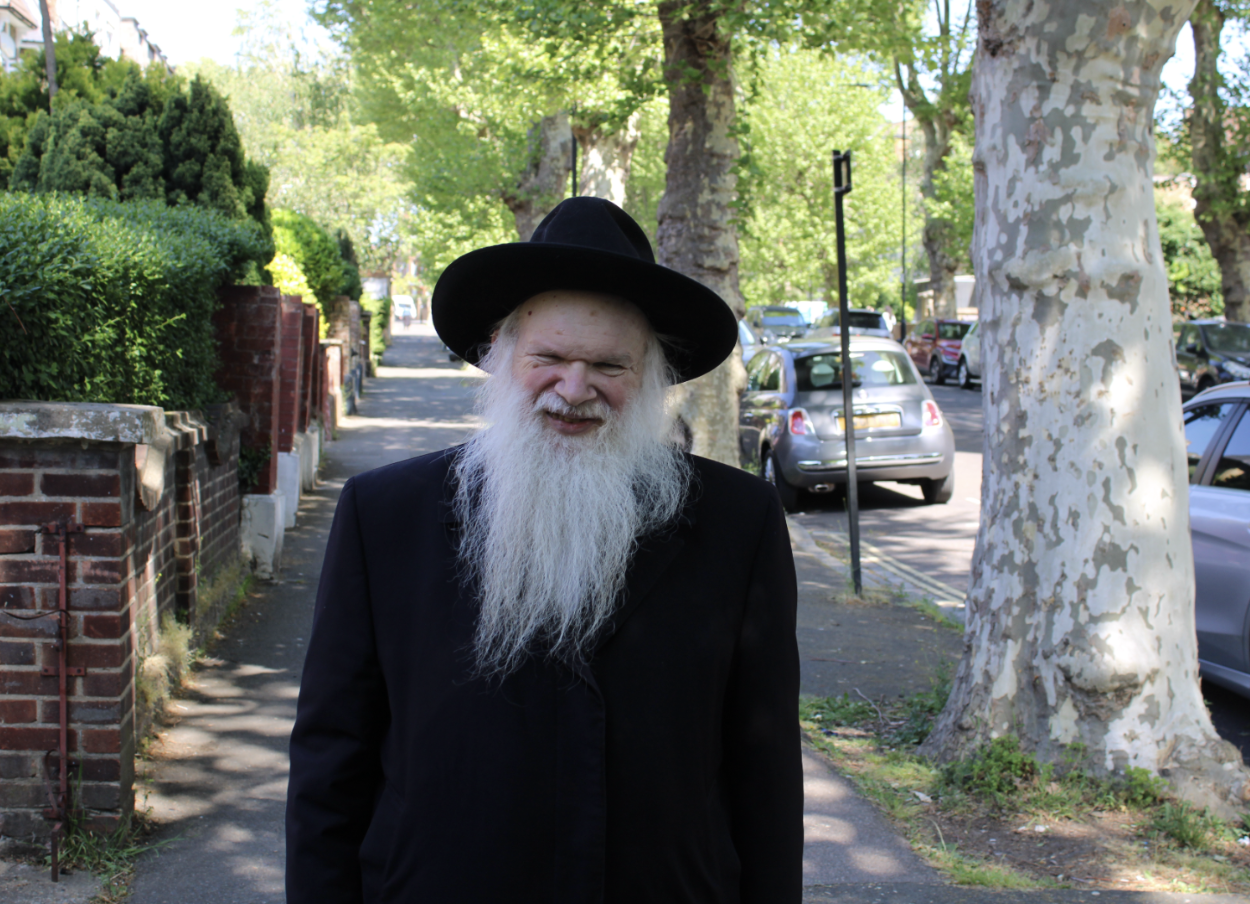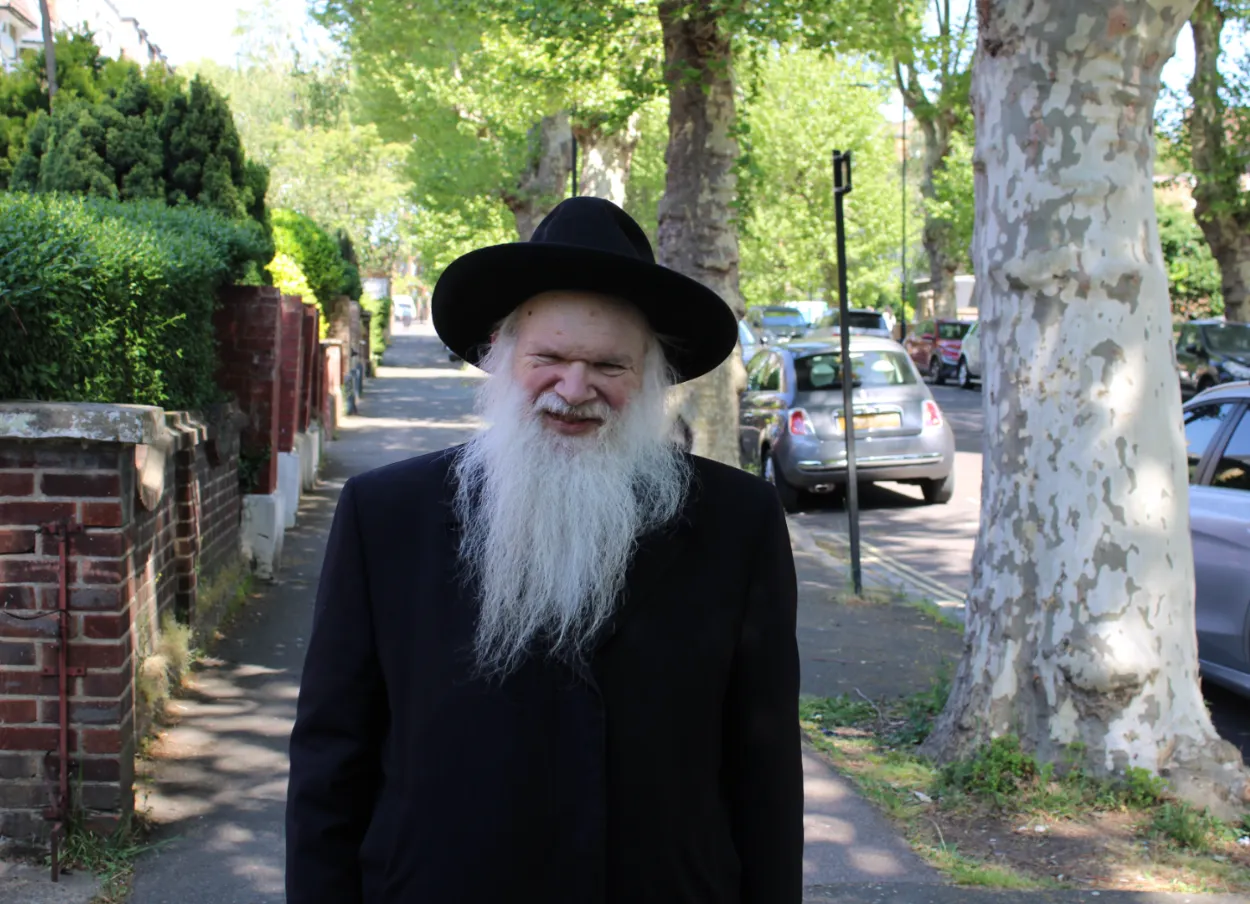
Towards the end of our interview, Rabbi Herschel Gluck suggests that we go for a walk. It’s a gorgeous spring day and he’s keen to show me how his community lives harmoniously with Muslims, Christians and atheists alike.
With an unruly white beard and sharp, twinkling eyes, Herschel cuts an avuncular figure. When I sat down at his table in his book-lined dining room two hours earlier, decorated with framed certificates of his services to inter-faith harmony, and featuring a large oil painting of a Rabbi peering down at us, he insisted on setting down coffee and shortcake.
“To be eaten,” he stressed jokingly. “It is not an artistic installation.”
We leave the house he raised his eight children in, a large property right next door to where his parents lived until they died in 2009. The pair of us take a left on one of the broad, tree-lined streets where Stoke Newington blends into Stamford Hill.
Our weekend stories are free for all to read — but we can only produce this kind of work with your help . If you're a fan of today's piece, please do consider becoming a paying member.
We walk past several synagogues, Jewish schools, as Herschel pointedly greets practically every person we walk past. Babies, people on the other side of the street, taxi drivers, men in parked cars — nobody is safe from being waved at or, preferably, having their hand shaken as Herschel trundles amiably past.
I’m conscious that this is the message that Herschel is keen to portray, the reason he’s invited me to walk with him: to show that last Wednesday’s knife attack in Golders Green has not cowed him, or made him fear his neighbours or hide away as a Jewish Londoner; to show that the long tradition of Jews living and thriving in this city is not going to change in the face of violence and terror.
That’s a live question. When I was reporting in Golders Green a few hours after the attack last week, a checkout assistant in a kosher deli told me that some people she knows are packing up and moving to Israel — or at least saying they will. “I’ll tell you why,” one of her customers butted in. “Because I’m from there and it’s more safe than being here.”
For around 400 years, London has been a safe harbour for Jews in trouble: Sephardi Jews in the mid-seventeenth century escaping the Spanish and Portuguese Inquisitions; Russian, Polish and Lithuanian Jews escaping pogroms in the late-nineteenth century; German, Austrian and Czechoslovakian Jews escaping Hitler. Jews were barred from England in 1290 by King Edward I, and it was only when Oliver Cromwell lifted the ban in 1656 that the city began allowing Jews to live with relative freedom.
These waves of escape to London have formed one of the city’s most enduring communities. London contains around 15% of Brits but around 54% of British Jews, according to the 2021 census, and many of them are concentrated in a northwestern arc from Stamford Hill through Golders Green and Edgware up to Radlett in Hertfordshire.
But how did Jewish north London get formed in the first place? And what do Jews in these areas think about the risks of being “visibly” Jewish in London now after a spate of recent attacks, including the firebombing of four Hatzola ambulances in March, two bottles containing petrol being thrown at the Finchley Reform Synagogue in April and then two Jewish men being stabbed last week?
A Place Of Delightful Prospects
Prior to the 19th century, the Jewish community in Britain was relatively small and “disproportionately affluent,” explains Gavin Schaffer, a professor at Manchester Metropolitan University who grew up in London. Gavin is the author of a recent book about the history of Jews since 1945, and he says his family’s journey across the capital is typical. His grandfather on his dad’s side lived in the East End and then the family moved to Stamford Hill. His dad grew up in Edgware, and his mum now lives in Radlett, one of the fastest-growing Jewish communities on London’s fringes.
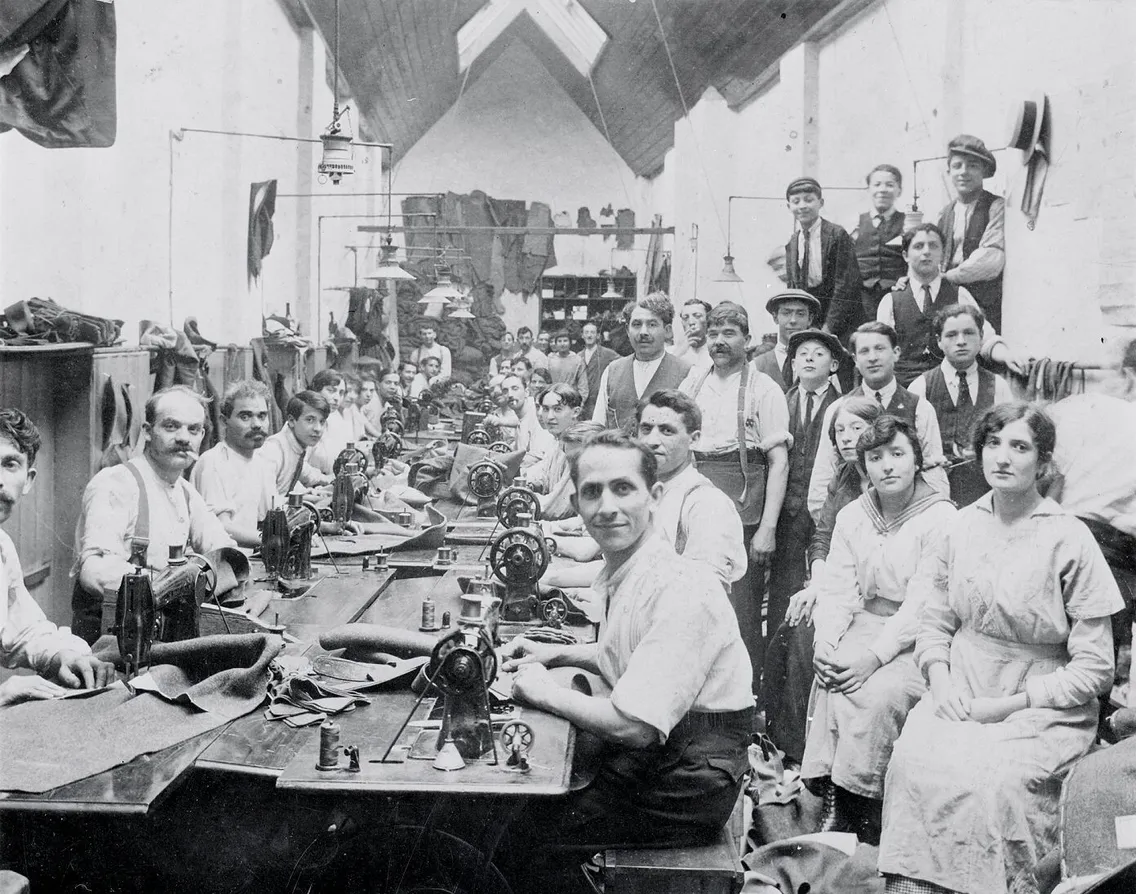
“It’s a classic immigrant journey,” Gavin says, and he’s right. But the migration of Jewish London from the East of the city to the North and North West has been a complex and closely-studied process.
In the beginning of the 20th century, roughly 125,000 Jews were living in the East End — many of them having only arrived in the couple of decades years before, living in cramped and dirty houses. Hannah Ewence from Chester University has written extensively about Jewish migration to London and tells me how the UK’s Jewish population took off around the late 1800s. After Alexander II was assassinated in 1881, the Russian empire’s Jews found themselves targeted and they fled en masse, with the Jewish population in England increasing roughly tenfold in the twenty or so years to 1905.
Hannah suggests that London’s establishment Jews at the time made a concerted effort to move these people out and encourage them to settle further afield, in areas like Golders Green and Hampstead. As working class Jews continued to arrive, there was a sense among some more elite figures in London Jewry that the growth of a highly visible and often Yiddish-speaking community was damaging the reputation of Jews and could put people at risk.
In 1888, the Jewish Chronicle published an editorial which said:
“If poor Jews will persist in appropriating to themselves whole streets, in the same districts, if they will conscientiously persevere in the seemingly harmless practice of congregating in a body at prominent points in a great public thoroughfare like the Whitechapel or Commercial Road, drawing to their peculiarities of dress, of language and of manner, the attention which they might otherwise escape, can there be any wonder that the vulgar prejudices of which they are the objects should be kept alive and strengthened?”
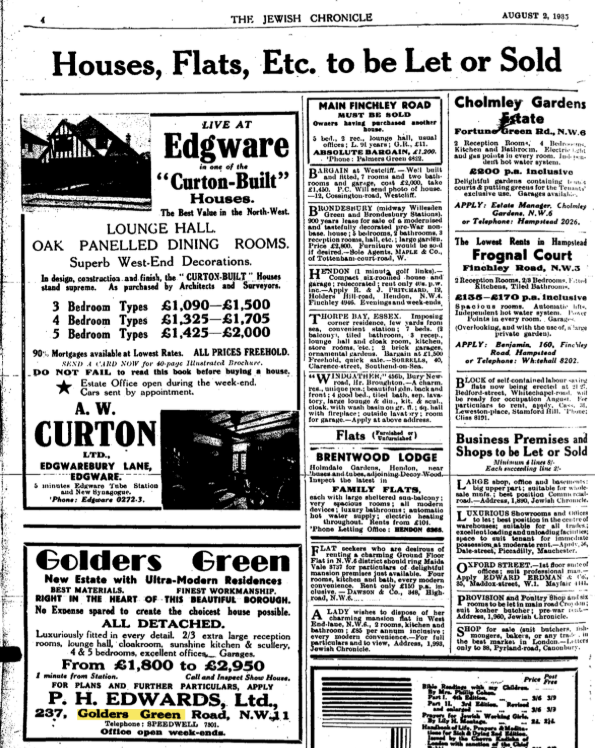
By the early and mid 20th century, property developers and Jewish cultural institutions began making a concerted effort to market leafy, suburban areas for Jewish East Enders to move to. The Underground Electric Railway Company built a tube station in Golders Green in 1907, an area which they then marketed as “A Place Of Delightful Prospects”. Golders Green’s first synagogue, the Golders Green United Synagogue was built in 1922, after the congregation which had previously been meeting regularly at the local Parish Church grew too large to accommodate the growing numbers of people.
In Hannah’s telling, this movement out to the suburbs was driven at least partly by a desire to assimilate — a decision to respond to mounting antisemitism by sanding down some of the sharper and most visible edges of Jewish cultural expression.
When the Golders Green Synagogue was first built, it adopted a discreet architectural style. Built with elegant stone portico, tall fan windows in a Georgian style, the synagogue seemed designed to blend in rather than stand out.
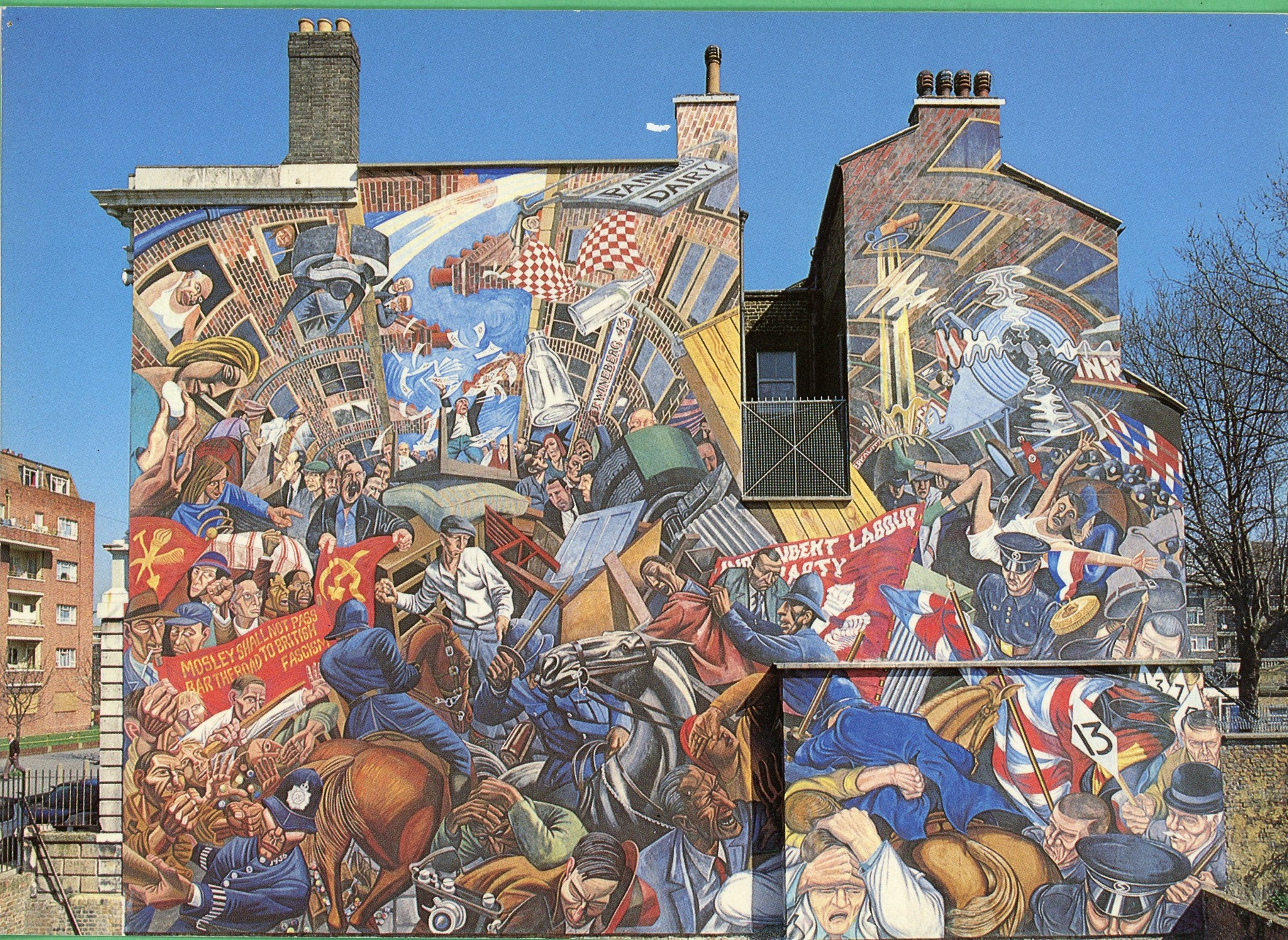
If you walk though Bethnal Green today you can still see the markers of the antisemitism that contributed towards the movement of Jewish people up and out of the East End. The Cable Street Mural — painted over 1979–1983 by Dave Binnington, Paul Butler, Ray Walker and Desmond Rochfort — depicts the time in 1936 when thousands of working class Londoners blockaded Oswald Mosley’s British Union of Fascists to march through the street and confront the area’s heavily Jewish population.
Around this time, Jews across Europe were beginning to flee the Nazis and the rising tide of antisemitism. Both Hannah and Professor Tony Kushner, a historian of Jewish migration at the university of Southampton, say that unlike the largely Russian emigres of the late 1800s, these arrivals mostly did not go to the East End. Instead they went to “bedsitland”, as Tony puts it — to cramped, dirty shared houses in the leafy areas that the Jewish Chronicle and the Jewish Board of Deputies had been marketing for the past few decades. This consolidated these areas as centres of Jewish life in London.
German bombing of the East End during WW2 seemed to compound the sense that the East End was no longer the place to be. By 1945, despite London’s Jewish population hitting around a quarter of a million people, only about 30,000 remained in the East End.
Through a series of interviews with Jewish Londoners in the early 1950s, the sociologist Howard Brotz captured the sense of aspiration that was driving London’s Jewish communities northwards. “When I buy a parcel in a West End store to be sent, and they ask for the address, I feel much prouder that it goes to N.W.4 than to E.1,” one person admitted. “It’s a nicer feeling.”
‘Not losing that umbilical cord’
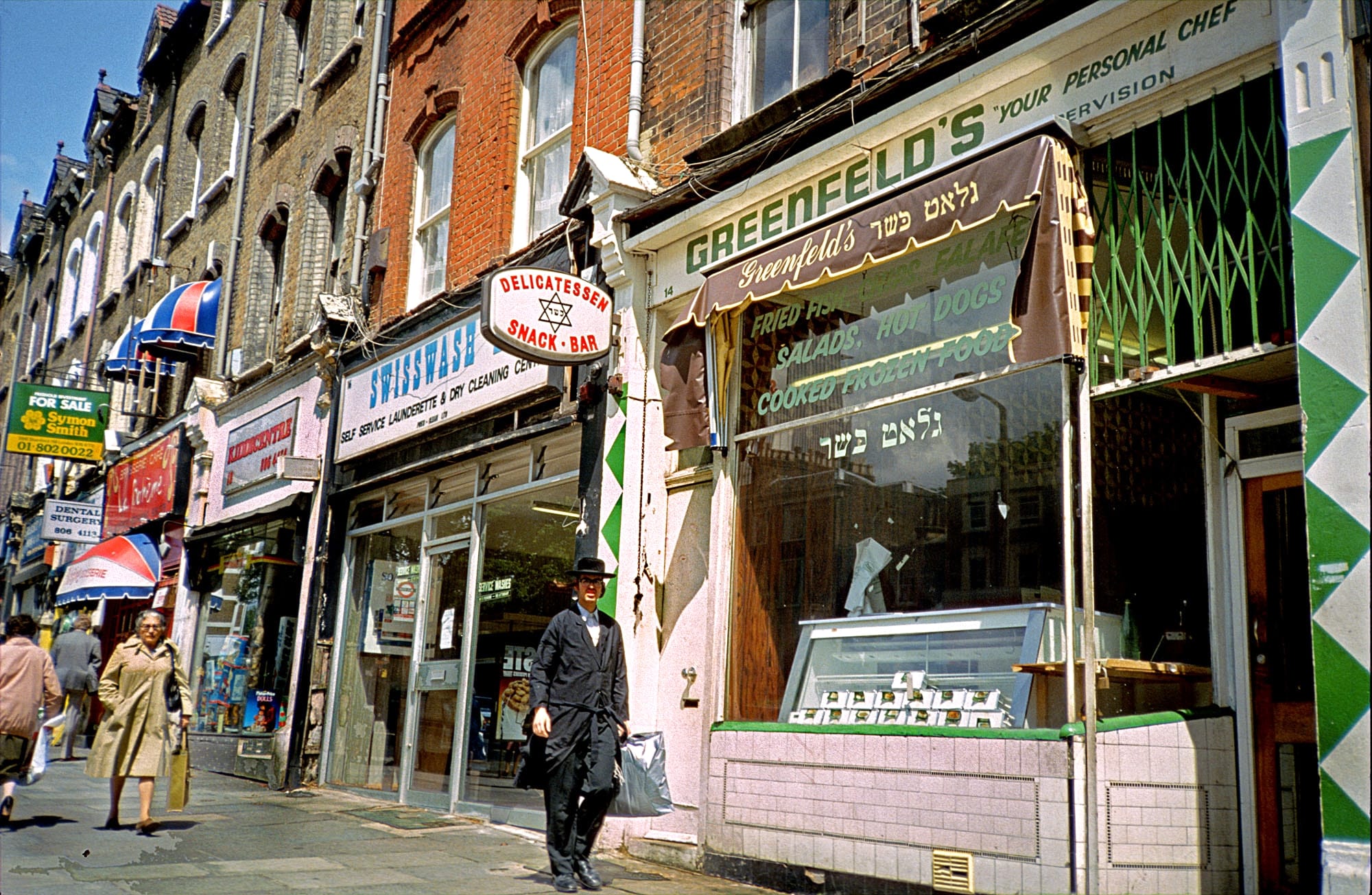
While many Jews moved to areas like Golders Green and Edgware, Herschel tells me that some in the Haredi (sometimes referred to as Ultra-Orthodox) community wanted to lay down roots closer to the East End. In 1926, the Union of Orthodox Jewish communities was established on Green Lanes in Haringey. “That was the mother synagogue of the Haredi community in this neighbourhood”, he explains, chosen because the social conditions, the accommodation, the air was much better than at the time in the East End. Yet it was still close enough to those who didn’t want to move. “It was moving away from the East End, but not losing that umbilical cord, that essential connection with the East End and the Jewish life there.”
It was to Stamford Hill that his parents first arrived as they fled persecution in Europe. Herschel’s mother stepped off a Kindertransport train at Liverpool Street Station in December 1938, leaving behind for good her life in Austria following Germany’s annexation. The Board of Deputies of British Jews found a sprawling bedsit in Stamford Hill for her to share with around 100 other children, a stop gap until she was sent to Nottingham to work before returning before the end of the war. Herschel’s father came from Belgium in 1939, where he was studying at a Talmudical college in a boarding house, his parents having already made the move to London a couple of years before. It wasn’t until 1953 that the pair met. As tens of thousands of European Jews embedded themselves in London and the East End continued to empty out, Stamford Hill consolidated its identity as a hub of Haredi life.
Far from being an area in which people sought to downplay their Jewishness, Herschel says, Stamford Hill became somewhere Haredi piety was defiantly celebrated. “You had some of the most eminent Jewish rabbis, scholars, holy men living in this area”, Herschel booms, gesticulating emphatically. Community leaders fomented a breathing, living Jewish life, where the streets were full of people who went daily to the synagogue, who studied the Torah and kept Shabbat. “It was the spiritual centre of Jewish life in the United Kingdom and the most vibrant Jewish area in the country.”
Stamford Hill in the latter stages of the 20th century attracted waves of Jewish migration, often associated with the collapse of the British empire and the rise in antisemitic violence in middle eastern nations. Almost the entire Jewish population of Aden, a former British colony in the southern part of modern-day Yemen, fled the country in the 20 years from 1947 — arriving with few possessions to the streets of London. Herschel was only a child when he first saw them, no more than 10, but old enough to recognise the trauma.
“I could see it on their faces. I could see it on the way they walked,” Herschel reflects, often pausing for long stretches to roam deep into his memories. “They were very into themselves. There was a certain sadness about them.” Rather than spawn new communities elsewhere, the Adeni Jews set up their own synagogue right alongside the existing Haredi community in Stamford Hill.
After some initial wariness, Herschel remembers dancing with the Adeni arrivals in the mid 60s in a hall next to one of the synagogues. People whirled around together in circles, he says, some with hands on the shoulders in front of them and others spinning sideways hand-in-hand. 60 years on, he can’t recall the names of anyone he danced with that day. “But I remember the unbridled joy and deep sense of connection that we felt with one another.”
Keeping faith in London
Can London still provide the safety that it’s promised – and largely delivered – to Jews for hundreds of years? There can be no definitive answer to a question like that, but Gavin Schaffer says that “the fear in the community at the moment is everywhere.” He notes that the chief rabbi Sir Ephraim Mirvis responded to Wednesday’s attack by saying that “if you are visibly Jewish, you're not safe,” but Gavin thinks it goes further than that, with fear extending to Reform or Liberal Jews who tend not to wear visible markers of their Jewishness outside of synagogue. “I would say that even though you’re not visible, you can still feel it,” he says. “People are really frightened.”
Gavin is in an interesting position. Last year, he published a book (An Unorthodox History: British Jews since 1945) which mostly treated the story of Jews in Britain as a positive story. On the book’s final page he laid out the “contradiction of British Jewry in contemporary Britain; a safe and successful community dogged by the persistent feeling that it is unsafe and at risk.”
Would he write the same line now, in light of recent events, including the attack on a Manchester synagogue last year, which was the first time since the 1960s (or perhaps the 1940s, it is contested) that a Jewish person was killed for being Jewish in Britain. “Probably not, not the same way,” he says. “My feeling when I wrote the book was that yes, antisemitism is real and a threat, but that we’re more embedded and secure than we realise. I still think that, but if I wrote that now, I would write it more cautiously.”
Despite the talk of Britain’s Jews leaving for Israel, so far the numbers don’t record an unusual exodus. 742 people emigrated to Israel from the UK in 2025 – the highest annual count for over 40 years, according to data from the Institute for Jewish Policy Research. But the report notes that “taking the past three years together, an average of 566 British Jews made aliyah [migrated to Israel] per annum – close to the annual average over the past two decades.”
That may change in light of recent events, but Hannah tells me that she’s encountering many other Jewish people in other parts of the UK who are moving to London. London is where the jobs are, and in other cities like Liverpool and Leeds, the Jewish population is on the decline. She was at the Princess Road Synagogue in Liverpool a few weeks ago, a stunning redbrick building first opened in 1874. But “they cannot get above 10 men to a service and you need 10 men in order to run your service. And that's because Jews are simply moving away from the city.” Recent attacks may suggest to some people that London is dangerous for Jews, but there is also a feeling of strength and comfort in numbers.
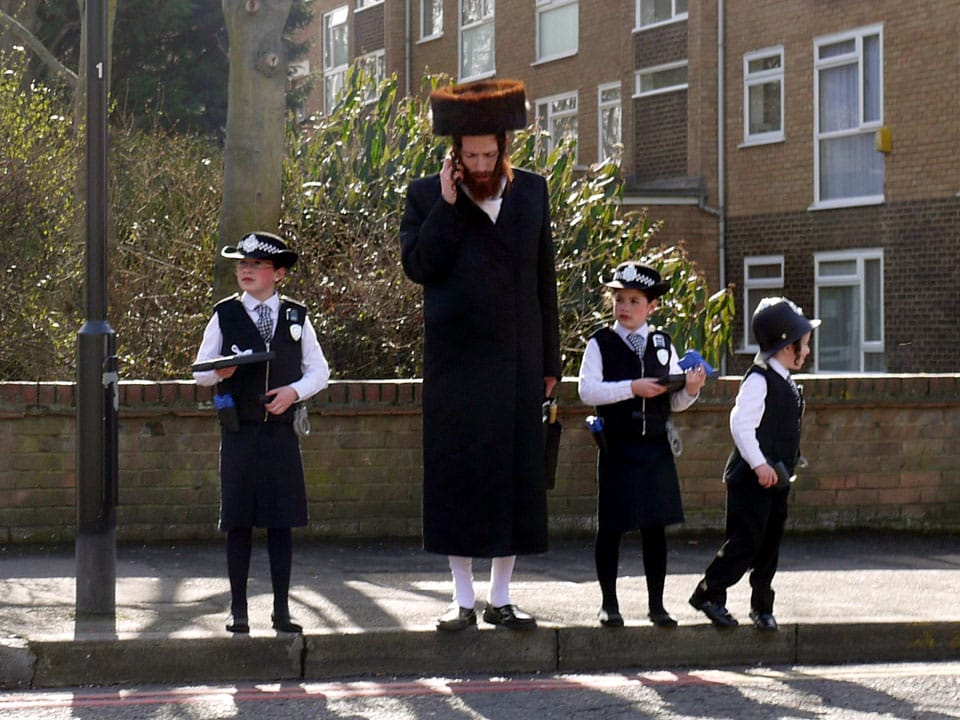
In Hannah’s telling, it was the concern over overt displays of Jewishness — coupled with a desire for a roomier life — that first led some Jewish leaders to advocate for moving the communities northward in the capital. But when I ask Herschel about the tension of the last few weeks, he argues that his community here should feel no reason to be afraid or mask their Jewishness.
He’s keen to introduce me to other members of the Haredi community, like Yahuda — a young man pushing a grey stroller, with thick brown curls. While most agree that Stamford Hill feels safe, Yahuda tells me that being obviously orthodox Jewish has led to people harassing him in the street outside the area. “I was in Enfield the other day and somebody shouted ‘Free Palestine’ at me,” he says, but on the whole he emphasises that London does feel safe.
Another man, around his 40s, tall and thin and of a darker complexion, also called Yahuda, reflects on what London has to offer. When I visited Golders Green in the aftermath of Wednesday’s attack, I met several people talking about leaving London for the perceived safety of Israel. Yahuda laughs slightly incredulously at this. “London is very good,” he says quickly. “Very good. Other places can be more dangerous. If you go to Israel it’s more dangerous — every day sirens.”
For him, for Herschel, London is still the place to be, where he feels comfortable living in a multi-ethnic area in full embrace of his faith. The sun is beating down heavily now; he’s about to leave me to visit one of the victims of Wednesday’s attack at his home in Stamford Hill, having only been up in Golders Green for the day. “This is where we are,” says Herschel. “The city is our natural habitat and we deeply appreciate that. And we hope, thanks god, that we can continue.”
Additional reporting: Joshi Herrmann.