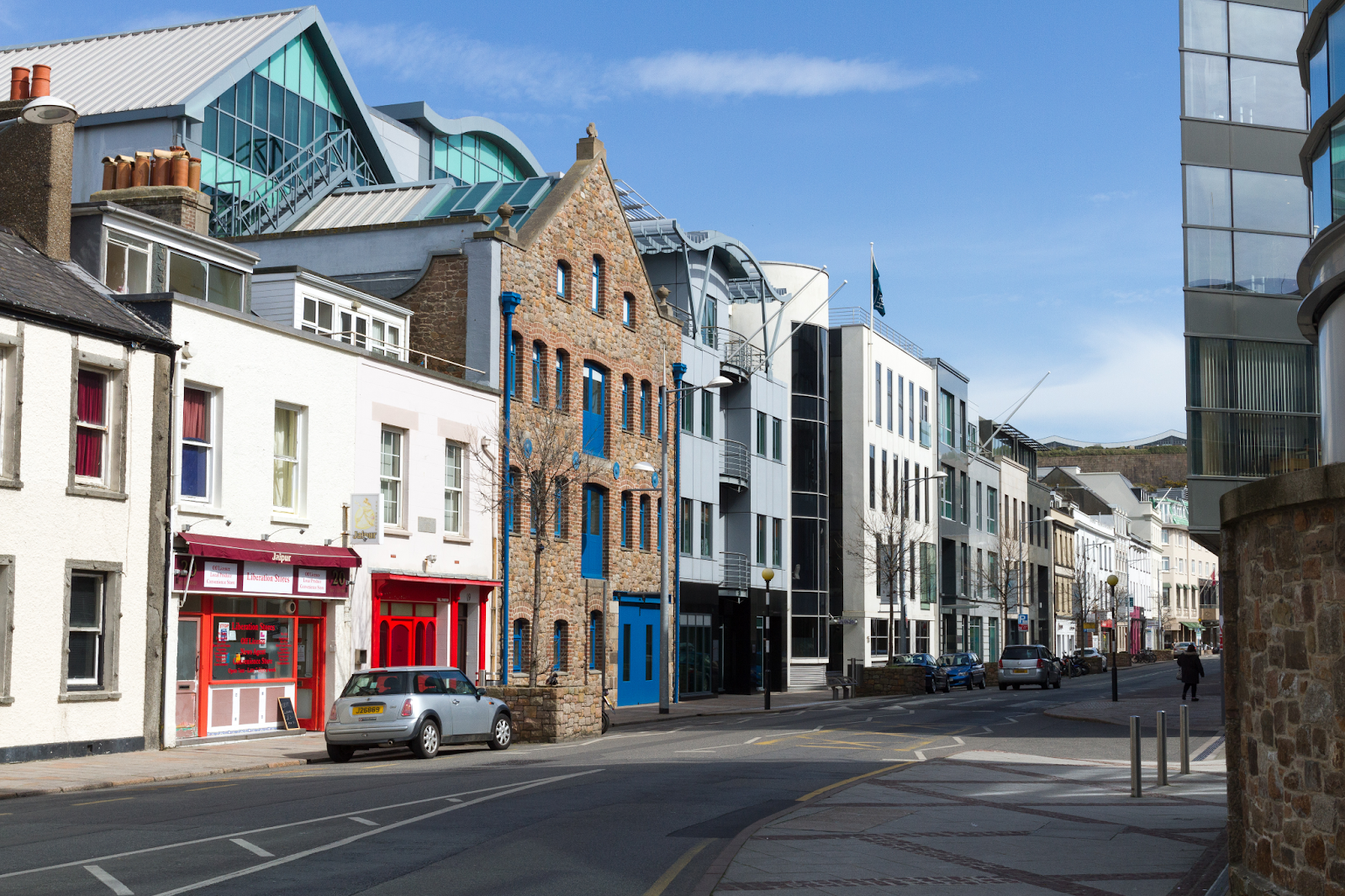
The Esplanade isn’t much to look at. Just 800 metres long, the street in St Helier, Jersey, is a mixture of nondescript low rise new builds that block out the view to the nearby docks. It’s home to the island's only bus station, as well as budget cafes, run-down Indian restaurants and skeezy late night bars — all occasionally interspersed with the odd luxury apartment or understated office block.
It’s also where 2,224 of London’s most expensive and recognisable properties are all registered to. At least, that’s according to the official records.
While it's well-known to the average Londoner that every inch of this city — from cavernous super-basements to the air above Canary Wharf offices — has become a prized asset for offshore investors, what hasn't been known is who those investors are. Due to lax regulation, it’s been near-impossible to find the real owners of these buildings, who often hide behind firms registered in foreign tax havens like Jersey. In fact, much of who owns our city has long been utterly opaque.
But now, The Londoner can reveal that some 32,611 properties in London are owned by overseas entities. We can do this because a recent change in the law is forcing these foreign companies to register their real owners. While the motivation behind the opacity might in some cases be benign (perhaps for privacy concerns, structuring multinational operations or simplifying a portfolio), the Register of Overseas Entities has been established to improve transparency around the ownership and control of overseas entities that own UK land.
We’ve spent the last week, using data compiled and shared with us by Dan Neidle of Tax Policy Associates, to go through thousands of those overseas entities to see who has bought up properties in the capital.
What we found was startling: a story that concerns some of London’s most iconic pubs, Camden market, President Trump's golf buddy and even an Oxford Street Harry Potter store whose landlord is seemingly the sanctioned Libyan government.
The street that owns London
So why are thousands of London properties owned via tiny companies on a non-descript street in Jersey? Let me explain. First of all, there are various reasons why these properties might be registered in this way, and being owned by a company in a tax haven does not mean that anything nefarious is going on. But let's say, hypothetically, you’re a businessman who wants to buy a small slice of Oxford Street or Soho, but perhaps you’re not too keen on taxes or transparency, or maybe you have some other need to own the property via a different entity.
Well, instead of purchasing it in your own name, the easiest solution is to set up a shell company — or use a management firm — to buy it in a tax haven like Jersey, where ownership of companies doesn’t have to be declared. While you still actually control the property, on all publicly accessible records there’s no way to trace it back to you.
And that’s how you end up in the situation where 432 London properties — mostly apartments in two luxury blocks in Canary Wharf and Greenwich Peninsula — can be run from companies all registered from one single address: 28 Esplanade. The building is an office that’s home to JTC, a fund management firm. But many of the addresses are little more than empty shells with a shared, overfilled P.O. box. After all, the companies registered to them don’t need to do anything operationally, other than being a name on formal documentation; a go-between for a wealthy aspiring landowner and the London land they so badly crave.
It’s a problem that has been a major hurdle for The Londoner before. Back in August last year, we were looking into controversial billionaire developer Asif Aziz, who we had been told was responsible for the closure and redevelopment of beloved pubs across the capital. But tracking his footprint was next to impossible, as his empire of properties is not primarily run through his public firm Criterion Capital — but through dozens of holding companies, most of which are registered in the Isle of Man, another tax haven.
 Andrew Kersley
The system began to change somewhat in 2022. While the practice wasn’t outlawed, the government passed a new rule mandating that any overseas entities that owned UK real estate had to register their real ownership with UK authorities. That disclosure allowed Dan Neidle and the Tax Policy Associates to create a database of all of those properties that they released in January. After seeing their stellar work, we reached out, and Neidle very kindly offered to share the vast swathes of raw data with us.
Finally, we were able to pull back the curtain on the capital’s overseas landlords.

Hi, editor Hannah here. Want to know precisely who owns the capital? To read all of today's groundbreaking investigation, all you need to do is put your email in below and join our mailing list for free. No card details, no ads: nothing but high-quality journalism about the capital.
This story is free to read. You just need to sign up to join The Londoner's mailling list. And why wouldn't you? You'll get our journalism in your inbox the second we publish, keeping up to date on this and all our stories. No card details required.
Already have an account? Sign In